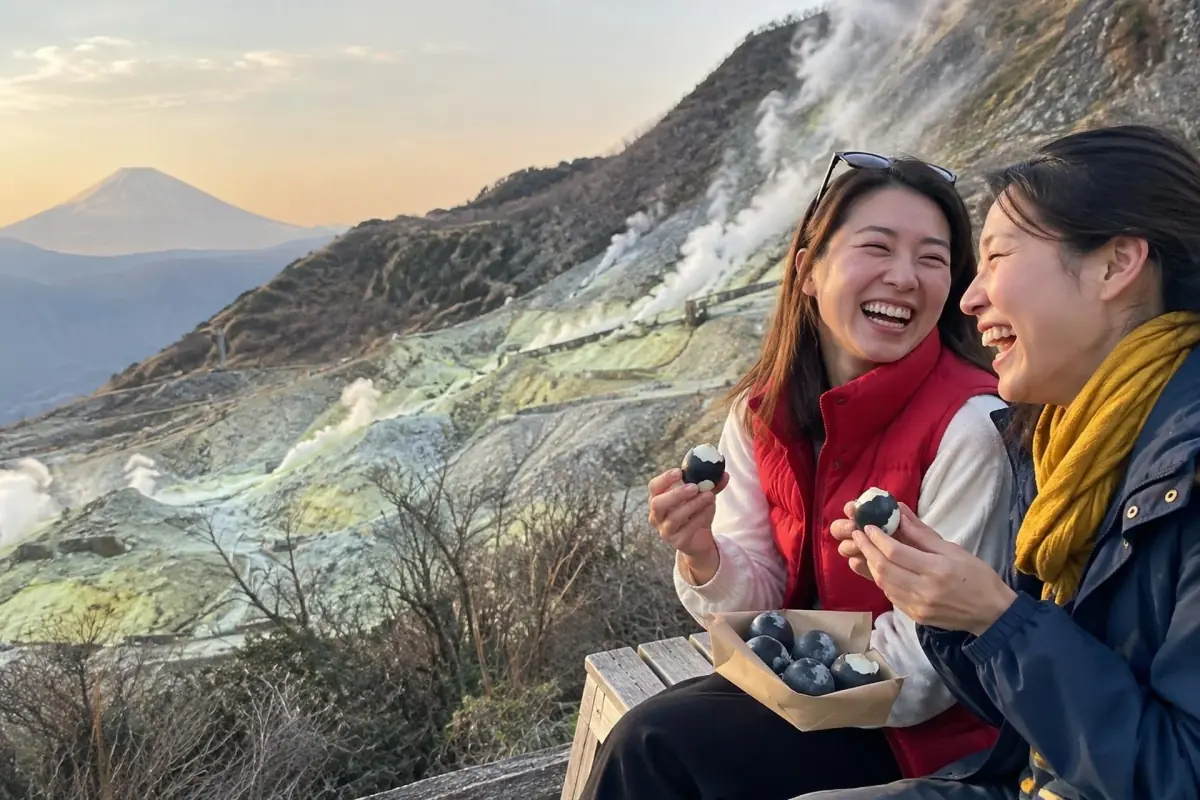
Things to do in Owakudani at a glance
Owakudani is a steaming volcanic valley in Hakone, and the things to do there start at its ropeway station: a gondola ride from Sounzan with cabins leaving about every minute, viewing decks, black eggs from the Kurotamago hall and a reserved nature trail of about 700 m. The visitor area lies at 1,040 m above sea level.
First come the station and the eggs, then the volcano and its trail, then the wider Hakone loop and the places around it. Where this site has a full guide for an entry, the entry links to it.

At Owakudani station (1 to 4)
The ropeway station, the viewing decks, the egg hall and the museum sit in one place.
1. Ride the Hakone Ropeway into the valley
The Hakone Ropeway runs from Sounzan to Owakudani, then on to Ubako and Togendai, with a change at Owakudani. Each section takes about 10 minutes. Adult fares since 1 October 2025 are 2,000 JPY one way and 3,000 JPY return. It runs 9:00 to 17:00 from February to November and 9:00 to 16:15 in December and January. Our Hakone ropeway guide covers tickets and stations.
2. Look over the valley from the viewing decks
Owakudani station has viewing decks on the station level and the forecourt. They are visitor areas in their own right, separate from the reserved nature trail. Mount Fuji shows only in clear weather.
3. Buy black eggs at the Kurotamago hall
A pack of four eggs costs 500 JPY including tax. The shells turn black through thermal water and volcanic gas, while the egg inside is not black. Eggs are sold from 9:00 to 16:40 and the shop opens 9:00 to 16:30; seasonal changes and sell-outs happen. Read more in our black eggs guide.
4. Step into the Hakone GeoMuseum
The GeoMuseum is on the ground floor of the Kurotamago hall and explains how the volcano formed, the geology and the thermal water supply. It opens 9:00 to 16:00, normally all year, though weather can close it. The information zone is free. The GEO Hall costs 100 JPY for adults and children, and preschool children enter free.
Tickets and day trips for Owakudani
Fuji and Hakone day trips from Tokyo, a two-day transport pass and guided tours that include the ropeway.
Hand-picked tours, booked through GetYourGuide. Prices are indicative starting prices in US dollars (as of November 2026). Tap a tour for live availability and the current price in your currency.

Hakone visit with bullet train return to Tokyo
- Lake Ashi Cruise fee
- Hakone Ropeway fee
- Bullet train ticket to Tokyo station
You return to Tokyo by bullet train to Tokyo Station. Lunch is included only with the lunch option; Ginza pickup is unavailable on weekends, holidays and certain dates.
Check availability →
Guided Hakone trip with cruise and ropeway
- Lake Ashi Cruise fee
- Hakone Ropeway fee
- English Speaking Tour Guide
The return to Tokyo is by bus. Lunch is included only with the lunch option; Ginza pickup is unavailable on weekends, holidays and certain dates.
Check availability →
Hakone ropeway trip from Tokyo
- Ticket for ropeway
- Driver and tour guide
- pick-up and drop off at designated point
Check the meeting point and departure time for your option.
Check availability →
Owakudani area trip with bilingual guide
- English & Chinese speaking Tour guide
- Comfortable vehicle with A/C
- Round-trip transfers
The free ropeway ticket is a limited-time offer. The Lake Ashi cruise costs extra.
Check availability →
Guided Owakudani area day trip
- Professional bilingual guide
- Comfortable vehicle with A/C
- Round-trip transfers
The ropeway is listed as a limited-time free offer. The Lake Ashi cruise costs extra.
Check availability →
Two-day Hakone transport pass from Shinjuku
- Round-trip train fare between Shinjuku Station and Odawara Station
- Unlimited rides on 8 transportation systems in Hakone
- Discounts at 70+ sightseeing facilities
The Romancecar supplement and Izu Hakone buses cost extra.
Check availability →Tickets and day trips for Owakudani
Fuji and Hakone day trips from Tokyo, a two-day transport pass and guided tours that include the ropeway.
The volcano and its trail (5 and 6)
Owakudani's history explains the landscape.
5. Trace how the valley got its name
Owakudani was once written 大地獄 and became 大涌谷 for the imperial visit of 1873. The local Geopark links the landscape to the collapse of the north side of Kamiyama about 3,000 years ago. A small eruption followed in 2015, and the nature trail reopened in 2022 under special measures. Our Owakudani history page tells the full story.
6. Reserve a place on the nature trail
The nature trail is a loop of about 700 m and 40 minutes. Departures are at 10:00, 11:30, 13:00 and 14:30 with up to 30 participants and 2 safety staff. You reserve online and pay 800 JPY per person on site, cashless. Explanations are in Japanese only. Preschool children, pregnant women, stick users and people with the listed breathing or heart conditions cannot take part. See the nature trail guide.
Around the Hakone loop (7 to 9)
Owakudani is one stop on a chain of trains, a funicular, ropeway sections, boats and buses.
7. Use the Hakone Free Pass
From Shinjuku, a 2-day Free Pass costs 7,100 JPY for adults and 1,600 JPY for children (prices since 1 October 2025). It gives unlimited rides on 8 transport types in its area, including the ropeway. Two days means consecutive calendar days, not 48 hours. Our Hakone Free Pass guide explains what it covers.
8. Continue by ropeway to Togendai
From Owakudani the ropeway goes on via Ubako to Togendai, where ropeway, boat and bus connect. Each station section takes about 10 minutes.
9. Go with a private driver
Private trips run with a driver and a vehicle for your own group. All three options come with hotel pickup. One includes return ropeway tickets. On the other two, attraction tickets are extra, and one of them has a group price for up to five people. The private tours page compares them.
Around Owakudani in Hakone (10 to 12)
A garden, a sculpture park and the autumn colours round off the day.
10. Walk through Gora Park
Gora is the change point between the mountain railway and the funicular to Sounzan. Gora Park opens 9:00 to 17:00 from March to November (last entry 16:30) and 9:30 to 16:30 from December to February (last entry 16:00). Admission is 650 JPY for adults and free with a Free Pass. Paths are steep, and wheelchairs and pushchairs are not allowed. The park's tea house serves matcha with a sweet for 750 JPY.
11. See sculptures at the Hakone Open-Air Museum
The Open-Air Museum in Ninotaira opened in 1969 and shows sculpture outdoors. It is open 9:00 to 17:00 all year, with last entry at 16:30. Adults pay 2,000 JPY at the desk or 1,800 JPY online, and preschool children enter free. Do not touch the artworks or step on roped-off lawns.
12. Time your visit for the autumn leaves
The ropeway operator's FAQ names late October to mid-November as the usual window for autumn colour. A Gora Park report of 2 November 2026 said the leaves there were still to come, so timing varies by place. In long-term averages for 1991 to 2020, December is the driest month and September the wettest. Our best time to visit page has the monthly figures.
Practical: time, transport and safety at Owakudani
Owakudani follows fixed opening times, weather and gas conditions.
Times to plan around
The nature trail takes 40 minutes, and each ropeway section about 10 minutes. The visitor car park runs 9:00 to 16:20 from February to November (exit by 16:40) and 9:00 to 16:00 in December and January. Wind, thunderstorms, typhoons and raised gas levels can interrupt the ropeway, so plan the return trip with a margin.
Health warning
In its notice of 27 May 2026 the prefecture asks people with asthma, bronchial, respiratory or heart conditions, and pacemaker wearers, not to visit Owakudani as tourists, because the gas may be life-threatening. The ropeway operator does not carry these groups between Sounzan and Ubako.
Getting there and staying
The usual chain runs from Hakone-Yumoto by mountain railway to Gora, by funicular to Sounzan and by ropeway to Owakudani. The Romancecar takes about 80 minutes from Shinjuku to Hakone-Yumoto. See how to get to Owakudani and where to stay near Owakudani.
Things to do in Owakudani: frequently asked questions
What is Owakudani known for?
Owakudani is known for its steaming volcanic valley in Hakone, its black eggs and the Hakone Ropeway that stops there. The egg shells turn black through thermal water and volcanic gas. On 3 November 2026 the Japan Meteorological Agency showed alert level 1 for Hakone, meaning an active volcano that calls for caution.
What is there to do at Owakudani?
Ride the Hakone Ropeway, look over the valley from the viewing decks, buy black eggs (four for 500 JPY) and visit the GeoMuseum. The nature trail takes about 40 minutes but needs an online reservation and 800 JPY per person. The Free Pass covers the wider loop through Hakone.
How much does the ropeway to Owakudani cost?
Adults pay 2,000 JPY one way and 3,000 JPY return, and children 700 and 1,000 JPY, since 1 October 2025. The nature trail adds 800 JPY per person, and four black eggs cost 500 JPY. A 2-day Free Pass from Shinjuku costs 7,100 JPY for adults.
Can everyone visit Owakudani?
No. The prefecture's notice of 27 May 2026 asks people with asthma, bronchial, respiratory or heart conditions, and pacemaker wearers, not to visit as tourists, because volcanic gas may be life-threatening. The ropeway operator also does not carry these groups between Sounzan and Ubako.